As public sentiment sours on automatic license plate readers — particularly cameras operated by Flock Safety — state lawmakers on both sides of the aisle are introducing legislation to curtail their use across the commonwealth.
A trio of bills introduced recently range from an outright ban on fixed cameras to stiffened penalties for unauthorized data access.
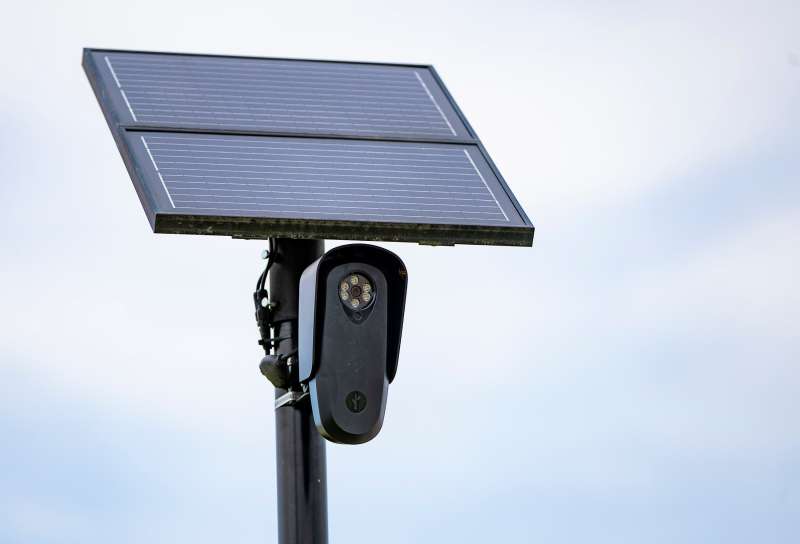
The cameras, known as ALPRs for short, capture images of passing vehicles and upload them to a database police can search. Officers may then use the data to locate vehicles that may be linked to crimes, missing people or other police matters.
But as the number of law enforcement officers accused of abusing the system has grown, so too have concerns about mass surveillance and privacy violations.
“There are legitimate circumstances in which this technology can assist law enforcement,” wrote Sen. Doug Mastriano (R-Franklin) in a legislative memo, naming a few examples. “But that is fundamentally different from continuously photographing and recording the movements of every motorist who happens to drive past a camera. Police should investigate people when there is a legitimate reason to suspect wrongdoing. Government should not surveil everyone in hopes of finding wrongdoing.”
His bill would limit permitted uses to stolen vehicles; missing or endangered person alerts; manhunts for “wanted or dangerous” individuals; vehicles “reasonably believed to be connected to a specific criminal investigations”; public safety threats that are “specific and articulable”; warrant searches; and other emergencies with imminent threats to life or safety.
Specific language, including proposed penalties and retention rules, hasn’t yet been drafted.
“A police officer with a legitimate reason to look for a particular vehicle should have the tools necessary to do the job. What government should not have is the ability to record the movements of millions of innocent Pennsylvanians simply because someday someone might want to search those records,” Mastriano continued.
A dataset and map compiled by the Electronic Frontier Foundation reports that more than 450 law enforcement agencies in Pennsylvania utilize ALPRs, but doesn’t detail where or how many cameras each organization uses. Some websites have attempted to crowdsource that data, documenting upwards of 2,600 ALPRs across the state.
Safety considerations
Earlier this summer, the Washington Post reported that at least 50 law enforcement officers nationwide have been charged or accused of misusing Flock and similar systems to spy on their spouses or intimate partners, exes and their exes’ new partners.
The Post story included an account of a mother from Armstrong County, who said she repeatedly warned police and the district attorney’s office that her police officer husband had used a competitor to Flock to stalk and threaten her. The officer, Michael McSherry, ultimately pleaded guilty to official oppression and served about 11 months in jail, according to the article.
Shortly after, Flock tightened its privacy and oversight controls, recommending data retention for seven days — rather than 30 — and adding tools to restrict data sharing and identify potentially abusive searches.
Referencing the above story, a proposal from Sen. Lisa Boscola (D-Northampton) would “ban knowingly accessing or using an automated surveillance system, or information obtained through such a system, for an unauthorized personal or otherwise unlawful purpose.”
Individual users would be penalized, though specific language wasn’t immediately available.
In a recent public post, the Chambersburg Police Department in Franklin County shared its internal guidance for ALPRs from Motorola Solutions, a Flock competitor. Its three fixed cameras and six mobile cameras have been “transformative for community safety,” saying the system has been used in more than 500 criminal investigations since its installation in 2016.
“An ALPR hit alone is not probable cause for arrest or enforcement action. Officers must independently verify the authenticity of an ALPR hit through law enforcement databases before taking action,” the release continued.
Additionally, “system inquiries are tracked and limited to legitimate law enforcement purposes,” including associated report numbers and “clear” descriptions of reasoning. “Any misuse would result in departmental discipline and possible criminal violations,” the agency added.
The New Castle Police Department in Lawrence County shared its external search logs with the Capital-Star from over a three-year span, comprising more than 11 million records of searches from departments across the country. Its own agency ran just over 10,000 searches in that same period.
A majority of those searches, more than four out of five, did not list a case number, according to an analysis using an artificial intelligence agent. Many that did had vague or non-descriptive reasons, such as “sus,” “atl,” or “cj.”
Sen. Dan Laughlin (R-Erie) would prohibit “networked” ALPR systems that create automatically databases of every passing vehicle, saying they “could reveal where someone works, worships, receives medical care, spends personal time and who they associate with.”
The lawmaker was careful to clarify that vehicle-mounted license plate readers would still be allowable.
“Public safety is a responsibility we all take seriously, but it should not require building a surveillance network capable of tracking the daily movements of millions of innocent individuals,” Laughlin said. “There is a clear difference between an officer using a license plate reader during police work and a permanent network collecting information about everyone who passes by.”
The latest bills are a departure from earlier legislation — one of which would have eased the ability to install cameras on state-owned infrastructure — but align with a House proposal that has seven cosponsors, including one Republican.
That measure, sponsored by Rep. Tarik Khan (D-Philadelphia), would grant private individuals the right to sue and authorize the state Attorney General’s Office and county district attorneys to investigate violations and bring civil enforcement actions.
At least 16 other states have limited their use, according to the National Conference of State Legislatures. Data must be deleted in California after 60 days unless it is evidence in a felony case while Vermont requires officers to be certified to access ALPR systems.