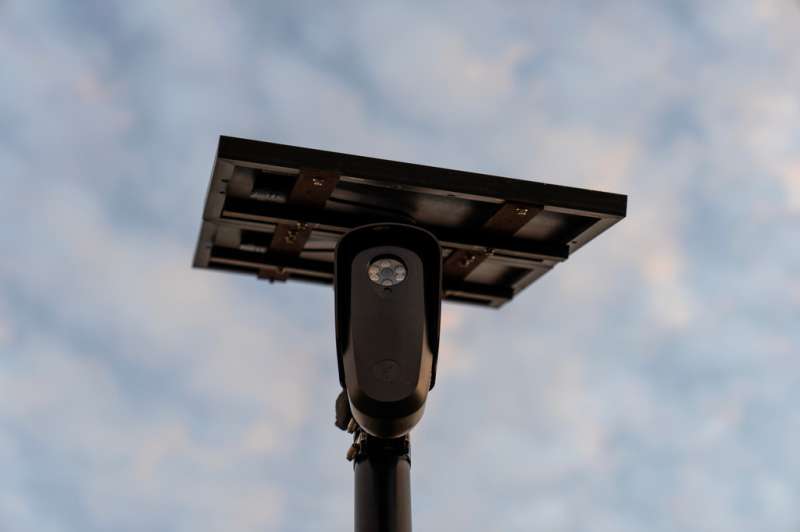
Franklin County is a microcosm of America as the debate over the use of Flock automated license plate readers heats up as summer nears its end.
After weeks of commentary by citizens against the camera network at government meetings and online, and vandalism of the devices on public and private property, Franklin County’s top law enforcement officers tried to lower the temperature by speaking to residents at a recent county commissioners’ meeting about why the technology promotes safety in the modern environment.
While most people who responded with public comments emphasized their support for police or took care to promote public discourse, emotions ran high on both sides of the argument.
Sheriff criticizes ‘misinformation’ over Flock cameras
Moving to a podium to face the crowd at the monthly evening meeting on Wednesday, Aug. 19, Franklin County Sheriff Ben Sites shared examples of how Flock cameras help police promote safety and order in the community.
Flock is not the only automated license plate reader out there — the Borough of Chambersburg has Motorola cameras, for example — but Sites said he chose the company because it was the best value. The commissioners unanimously approved the county’s contract with Flock Safety last October, agreeing to spend $4,500 to launch the platform in the county.
“It’s the most effective system. It’s the most effective system,” Sites said this week. “Why else did I pick them? Well, probably, unfortunately, for some of the reasons that they’re in the news. They care about privacy and transparency.”
Sites said Flock caught law enforcement officers misusing the system, and that it is a good thing because it shows guardrails are in place.
“There’s never been an instance of a data breach, and the systems are encrypted from point to point,” he said. “It doesn’t do minor infractions, it doesn’t do speed, it simply alerts to the (National Crime Information Center) database or legitimate law enforcement databases, or what we call hot lists. As something travels by, it takes a static photo of your license plate.”
Sites said vehicle owners have already agreed to keep a license plate on their cars so that governments can identify the registered owner and that automated license plate readers capture the same information an officer can in person.
Sites criticized the DeFlock Franklin County group for spreading what he called misinformation and propaganda, to jeers from the audience.
Franklin County district attorney: Case law supports Flock
District Attorney Ian Brink said it is up to the legislature and judiciary, not him, to decide if something is lawful. His job is to follow the law.
“I think there’s some disagreement regarding what the law says, but it’s very clear: A person traveling in an automobile on public thoroughfares has no reasonable expectation of privacy in his movements from one place to another. United States vs. Knotts.”
Brink pointed to a Pennsylvania Superior Court decision, Commonwealth vs. Watkins, which found that “a license plate reader and law enforcement’s use of an automated license plate reader data base, quote ‘does not infringe upon an individual’s reasonable expectation of privacy because it does not reveal intimate details of an individual’s daily life, not does it track a person’s every movement.’ “
He also cited courts in other states that issued similar findings.
The district attorney’s office only uses data from Flock cameras or other license plate readers that are tied to a criminal case.
“It’s not just looking at the general public, it’s very focused when a case is developed and an investigation is going on, that’s what they’re looking for,” Brink said. “To think that my office, the sheriff’s office or all of our law enforcement agencies in Franklin County have the time to sit there and look at all the volume of potential data that’s there just to seek out to potentially prosecute additional matters, the time is just not there to do that and we’re not doing that.”
Citizens: Flock cameras aren’t the problem, the database is
“A single license plate scan means nothing …. but millions of scans mean a great deal,” said Greencastle resident Robert Clayton, who said he works in IT and data.
While Sites and Brink said only certain law enforcement officers can access their agency’s data from Flock and only do so in connection with a specific case, Clayton and others raised issues about the security of the system and how the data can be used.
“The real question is what this data can be used for in five, 10 years from now,” Clayton said. “Could government identify vehicles attending protests, gun shops, medical facilities, union meetings, political organizations? Could automated systems flag people when their movements resemble patterns someone considers suspicious?
John Patterson of Greene Township pointed to a case in Wisconsin where he said law enforcement used information about a resident passing back and forth to Michigan to prosecute him for marijuana possession. He raised concerns about the potential for such a case in Pennsylvania, given Maryland’s decriminalization of marijuana.
Patterson also responded to Sites’ question of why people care so much about Flock when they willingly sign over their personal data to tech companies such as Meta and Google and many more.
“It’s a choice,” Patterson said. “A camera monitoring us in public is not the same type of choice in my opinion.”
Pennsylvania lawmakers plan Flock legislation
State lawmakers announced plans this week to introduce bipartisan legislation to establish privacy and accountability protections for Flock cameras and other automated license plate reader systems.
The proposed legislation would establish safeguards designed to protect Pennsylvanians’ personal information and civil liberties, including rules governing access, documented reasons for searches, audit trails, data retention standards and transparency, according to a news release. It would also establish meaningful civil penalties for unauthorized access, use or disclosure; allow individuals harmed by misuse to bring a civil action; and authorize the Pennsylvania Attorney General and county district attorneys to investigate violations and bring civil enforcement actions.
“As a nurse, I know how deeply personal medical information is and why we have strong protections around who can access and use it,” said Rep. Tarik Khan, a Democrat from Philadelphia. “We need to think about license plate reader data in much the same way. If a record is being created of where you’ve been, there should be strict rules about protecting this data, including who can access that information, how it can be used and how long it can be kept, as well as real consequences if this data is misused.”