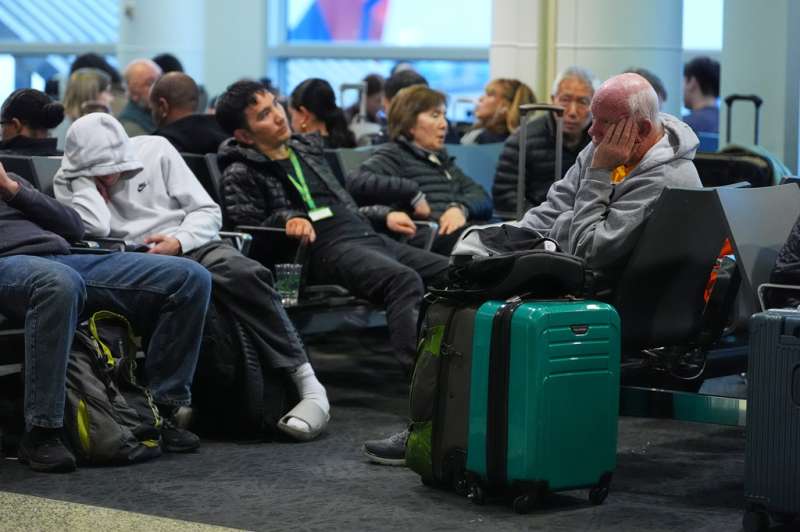
Airlines across the US worked to recover from the longest nationwide ground stop in 25 years that canceled thousands of flights Saturday, stranded hundreds of thousands of passengers, spread ripple effects around the world, and forced pro and college sports teams to scramble for alternate transportation.
New technology being added to the nation’s air traffic control system overloaded antiquated equipment and caused “intermittent” communications and radar gaps, leading to the flight shutdown of more than four hours, Trump administration officials said.
Planes were taking flight and landing Saturday, Secretary of Transportation Sean Duffy said, but the effects could be felt for days. Officials say the system will likely return to normal in time to handle the Thanksgiving travel rush.
As of Saturday morning, many flights were still delayed at Pennsylvania’s two largest airports, Philadelphia International Airport and Pittsburgh International Airport, with some flights canceled altogether.
Things were running more smoothly elsewhere in the state. Most flights appeared to be on time as of Saturday morning at Erie International Airport, Lehigh Valley International Airport, Wilkes-Barre/Scranton International Airport, and Harrisburg International Airport.
Passengers should check with their individual airlines for the status of their flights. Travelers can also get airport status updates via the Federal Aviation Administration’s (FAA) website.
An FAA computer problem is considered outside the control of the airlines — much like the weather.
So the only thing the airlines are obligated to do is to offer free rebooking on another flight for travelers that want to continue to their destinations or a refund if their flight was canceled and they decide not to take the trip.
The nationwide stop was the first since January 2023, when another key FAA computer system that sends notices to pilots malfunctioned, and the second since the Sept. 11, 2001, attacks.
Andrew Charlton, an aviation consultant, said Friday’s stoppage affected about a quarter of the 45,000 flights in the U.S. each day.
“The knock-on effect of that is incredible,” said Charlton, managing director of Aviation Advocacy. “The aircraft doesn’t just fly from A to B and back to B and then stop. It then moves onto C and then over to E and around and around and around. It is, of course, exacerbated if you’re talking about long-haul flights, international flights over the Atlantic or over the Pacific.”
Keystone senior newsletter editor Patrick Berkery contributed to this report.