For decades a Montgomery County Coroner’s Office storage room has served as the final resting place for the dead that no one wanted.
Nearly 300 rectangle boxes containing the cremated remains of unclaimed individuals, including four miscarried or stillborn children and four nameless people, with nowhere to go.
The oldest unclaimed remains are a local man who died in 1988. A record 61 people went unclaimed last year, according to Montgomery County coroner data. As of August, 29 people had gone unclaimed this year.
Dr. Janine Darby learned about the unclaimed dead numbers while attending a 2023 ribbon-cutting ceremony for the new coroner offices in Eagleville.
While touring the center, she found the room where the cremated remains of those whose deaths had been investigated by the coroner’s office were stored. It bothered her. A lot.“This was not a dignified resting place,” Darby said.
When she took over as county coroner in January 2024, she made it a priority to fix it.
Two years later, Montgomery County has broken ground for what will be one of only a handful of permanent final resting places for unclaimed remains in Pennsylvania.
“Everyone deserves to be remembered. Everyone deserves to be treated with dignity,” Darby said. “County coroners have a responsibility to ensure that those entrusted to our care have a permanent and respectful place of rest.”
But that does not always happen, as counties increasingly find themselves responsible for a growing number of unclaimed and abandoned dead, with little outside guidance.
How a 19th century law gives Pennsylvania coroners authority over unclaimed dead
Under an 1883 state law intended to discourage illegal grave robbing, once a common way Pennsylvania medical schools obtained bodies for anatomy classes, a body is legally considered unclaimed if no one comes forward within 36 hours of death.
The law, which remains in effect today, allows county coroners and medical examiners to then donate the bodies to scientific institutes for educational purposes..
Unclaimed bodies considered unfit for donation are stored for three months to give time for the next-of-kin to be located, though families can legally reject responsibility. When that happens, the county pays for a contracted funeral home to cremate the remains.
This gives Pennsylvania county coroners wide discretion over how they handle unclaimed bodies and remains. Most keep them in storage areas at county morgues, while others bury them at taxpayer expense in potter’s fields, mass graves or donated cemetery plots.
Since 2001, every two years the Erie County coroner’s office removes unclaimed remains stored in the courthouse basement and takes them to a local cemetery where volunteers scatter the ashes in a special public ceremony where the names of the dead are read out loud.
In 2018, the Chester County Coroner’s Office secured donated mausoleum vault space at Philadelphia Memorial Park in Frazer where more than 50 unclaimed people were interred.
The plan was to continue the practice every other year, but by 2022, the vault had reached capacity and interments stopped, according to the office. As of March 2025, the coroner’s office was storing 75 unclaimed remains in its morgue while awaiting arrangements for another vault.
More recently, Montour County Coroner’s Office, located in the central Pennsylvania, announced plans in 2024 to build a mausoleum for up to 1,000 unclaimed remains on donated land. Construction status of the project was not immediately known as of Nov. 12.
What to expect when the Montgomery County unclaimed mausoleum is unveiled
After taking office, Darby said she took her desire to create a final resting place for the unclaimed dead to county officials. She researched options and found grant funding for the project.
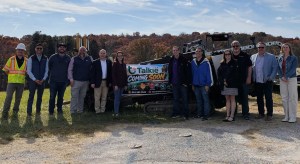
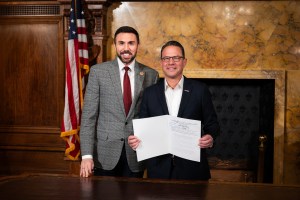
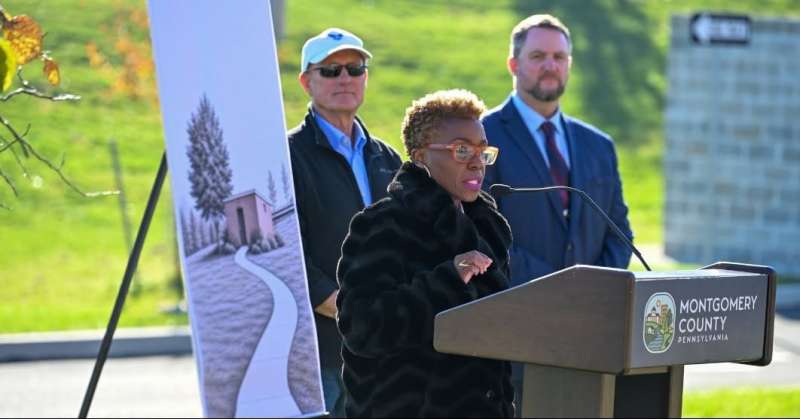
In a late October ceremony Darby and other county and state officials unveiled a sketch of the proposed 200-square-foot building, which, once completed, can hold up to 1,000 remains. It will be located in a wooded area near the coroner’s office.
Construction will begin soon and a nondenominational service is planned for Spring 2027, Darby said. After, the mausoleum will be accessible to the public, she said.
Montgomery County has posted the names of unclaimed individuals in its custody on its public website since 2019, a direct outcome inspired by the Bucks County Courier Times ongoing award-winning “Unclaimed Dead” series and a names database for Bucks and Montgomery counties.
The list is updated several times a year, and it has resulted in the remains of more than 130 people being reclaimed by family, friends, or estates who came forward, in some cases, years after the person died.
After remains are transferred to the mausoleum loved-ones can still claim them, Darby said.
At the October groundbreaking, Montgomery County Chief Operating Officer Lee Soltysiak noted that the mausoleum reflects the county’s commitment to honoring all people with respect and compassion.
“The measure of a community is how it treats people when they have no one else to advocate for them,” Soltysiak added.