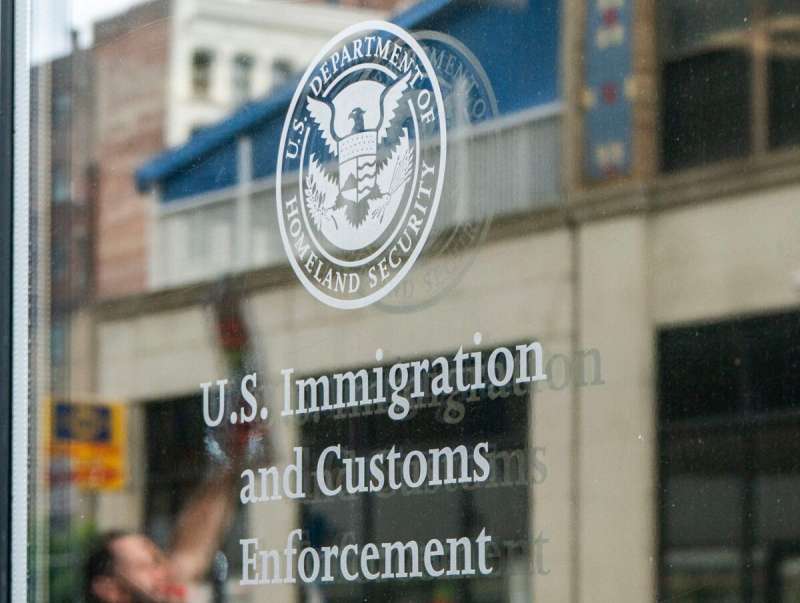
Earlier this month, a U.S. Immigration and Customs Enforcement operation targeted construction workers building an addition at the Geisinger Medical Center in Danville, Montour County. Along with local law enforcement, they stopped and arrested a number of workers on roads near the facility as the men left for the evening on Sept. 2.
While details have been difficult to verify — advocates, workers and law enforcement have told different stories, and few documents have been publicly released — the raid sent shockwaves through central Pennsylvania’s immigrant communities.
Two police chiefs in the county whose officers were involved in the operation, a spokesperson for ICE and a spokesperson for Geisinger all stressed that no arrests happened on the medical center campus itself.
But advocates warn that as word of raids near hospitals and medical centers spreads, so can fears of seeking healthcare services in immigrant communities. Medical workers too have warned that more aggressive immigration enforcement has led to immigrants delaying or refusing necessary care.
“People are afraid to go anywhere,” said Mirna Miranda, the Pennsylvania organizing director with We Are CASA, a national group dedicated to organizing and protecting the civil rights of immigrants. “It seems like [ICE] has no frontiers. They don’t care about people. They don’t care about whether there is a place where people go to get better, to survive.”
A spokesperson for the American Civil Liberties Union of Pennsylvania added, “just like ICE’s enforcement policies at schools and courthouses, conducting immigration raids at hospitals and medical centers compounds the deep sense of fear and anxiety in immigrant communities in Pennsylvania.”
Spokespeople for the U.S. Department of Homeland Security and ICE did not respond directly to questions about their policies around enforcement near medical centers or the impacts of their activity on immigrants’ access to care.
But a spokesperson for ICE sent a statement that read in part, “Under President [Donald] Trump, if you come into our country illegally and break our laws, we will find you, we will arrest you, and we will deport you. ICE enforces the law as written. What makes someone a target for immigration enforcement is whether or not they are illegally in the U.S. — full stop.”
The agency claimed that they “successfully arrested 10 illegal aliens in Danville, Pennsylvania, on September 2,” according to a statement. But advocates and a witness who spoke to the Capital-Star claim total arrests related to the incident, including some that took place at later dates and at worker housing, may exceed 40.
Studies show that both lawful and undocumented immigrants are more likely to be uninsured than U.S. citizens, and are much more likely to report barriers to healthcare. In the last year or so, an increasing number of immigrants in the U.S. have reported being afraid to leave their home for routine tasks and skipping medical care. Fear of disclosing their immigration status has also led some not to seek coverage they may qualify for.
Among respondents to a Kaiser Family Foundation/New York Times poll in 2025, around half of immigrant adults in the U.S., and nearly 80% of those in the country undocumented, said they are “somewhat” or “very” concerned about sharing their immigration status with healthcare providers.
On the first day of Trump’s second term, DHS moved to reverse a long-standing policy generally barring ICE agents from acting in and around so-called “sensitive” or “protected” areas. That included churches, schools and healthcare facilities.
Since then, immigration enforcement has surged, with the number of arrests growing in recent months.
While the current administration’s mass deportation campaign began with targeted and televised enforcement in major cities, often with resistance from locals, the arrests near Geisinger are more emblematic of how ICE’s tactics have changed in recent months. Increasingly, arrests are happening with the assistance of local law enforcement who have agreed to assist ICE through its 287(g) program, often through smaller operations targeting workplaces.
While no arrests appeared to have taken place on the Geisinger Medical Center campus, witnesses, including a construction worker and Geisinger employee, said they noticed the facilities being surveilled by unmarked SUVs with tinted windows leading up to the Sept. 2 arrests. That included seeing cars matching this description on Geisinger property.
A construction worker who requested anonymity for fear of retaliation from ICE and his employer, said that local police vehicles could be seen near exits to the hospital as he and his colleagues prepared to leave work that day.
Asked about the surveillance, a spokesperson for ICE said, “we would never divulge investigative practices.”
Mahoning Township Police Chief Frederick Dyroff III, who says his officers turned five people over to ICE on Sept. 2, refused to say whether his department’s resources, including an unmarked vehicle, were used to monitor the Geisinger Medical Center or construction workers working there.
He added that his officers were also parked on the road roughly a quarter mile to a half mile from the hospital, not directly outside its exits.
The Geisinger raid was not the first to target construction workers near a hospital in central Pennsylvania. Last August, ICE confirmed the arrests of 24 construction workers in Centre County who were on their way to a construction site at Mount Nittany Medical Center.
Miranda, the Pennsylvania organizing director with We Are CASA, said stories of immigration enforcement at sites like hospitals that once would have been considered generally off-limits for ICE have become increasingly common in the last year and a half. She said the results can be devastating for immigrant communities nearby.
She’s spoken with immigrants who have had to make difficult decisions about whether to seek medical care, for fear of risking arrest. When word gets out of ICE targeting places like medical centers that are important to communities, “people hesitate to go there, because they’ve seen really scary scenes.”
The impacts, she said, can be felt by American citizens as well, some of whom are afraid of being targeted because of their nationalities, accents or languages they speak.
“Our communities are afraid, and their lives have been changed. They’re avoiding being outside, in the parks, and barely coming out to the grocery stores, specifically lately,” she said. “Life, for our communities, is no longer a quality life. This is putting everyone in danger.”