The Middletown Supervisors could consider amending the township’s zoning laws permitting data centers in its light manufacturing zoning district, but the measure would require developers to meet a long list of strict requirements.
After months of work, the township’s planning commission has unanimously recommended amending the zoning ordinance to allow the controversial buildings housing IT infrastructure and equipment essential to digital information distribution in M-1 districts by conditional use.
So far, no developers have approached officials about opening a data center in Middletown, Director of Building and Zoning Jim Ennis said.
But the current zoning law also does not address the use, leaving the township vulnerable over where they can be located.
If data center plans are submitted before towns can update their rules, the proposals would fall under older zoning ordinances that officials in some towns say are insufficient to regulate data centers. Falls is also considering an update to regulate data centers.
“This is in no way trying to entice or promote someone to try and establish a data center in this township,” Ennis said, adding the changes are necessary to give the township control over the use.
The proposed 18-page amendment has undergone six revisions since it was first discussed earlier this year to create rules addressing size, height, lighting, noise, vibration, water, energy use, and a long list of other elements.
A final draft proposal was not immediately available, but it was discussed at length at the Nov. 4 planning commission meeting before the vote recommending its approval.
The policy adds guardrails for a host of requirements including one that requires a minimum gross tract size of 50 contiguous acres at the time a plan is submitted for it to be considered. The property cannot be bisected by roads, rail, utility or rights of way.
Data centers and their accessory uses would require 1,000-foot buffer zones from the boundary of residential zoning districts and the lot line of any so-called “sensitive receptor” properties.
The amendment would define “sensitive receptor” properties as including residential neighborhoods, schools, long-term care centers, hospitals and medical centers, park and recreation space, worship places, childcare centers, historical sites and retirement communities.
The 1000-foot setback mirrors requirements other communities have adopted or are considering in their data center rules, planning member Peter Tantala said.
In Middletown developers would also be required to submit emergency response plans prepared by a qualified professional that would need to be reviewed and accepted by the township’s fire and emergency management department as part of the conditional use process.
A data center would not gain approval unless an applicant demonstrated that procedures for fire suppression, containment, ventilation, and evacuation are sufficiently protective of public health, safety and welfare, under the draft.
Other requirements include buffering, screening, noise, water, sewage and electric usage, power supplies, aesthetics, parking, emergency management plans, natural resource and environmental protection and parking.
The Township would include in its data center definition buildings involving cryptocurrency, mining, blockchain transaction processing and server farms.
Where could a data center be built in Middletown?
Ennis pointed out that the township does not have many properties in its light-industrial district that would meet the 50-acre minimum size requirement to be considered, and barely any properties in the district are undevelopment that would meet the criteria.
“So it’s a long way of saying it would be very, very, very, very, very difficult for someone in this community to establish a data center,” he added.
But one planner noted that money is no object to data center developers, and they would offer property owners 10-times more than what a property is worth, if they felt they needed it.
Tantala said that his research shows there are about 200 properties spread over 1,000 acres in the M-1 district, which is most concentrated in six areas including around Cabot Boulevard, Wheeler Way, the Route 213 corridor, Big Oak and South Flowers Mill roads and Route 1.
He believes there is only one undeveloped property in the township that could potentially meet the 50-acre minimum lot size, but that there are a few other developed ones that could meet it, if properties were consolidated.
Tantala also expressed concerns if the ordinance addresses the potential that developed buildings within the M-1 district could be converted into data centers.
He also expressed a desire to make sure the rules apply to building conversions because as the technology improves, data centers will likely require a smaller footprint than the 10-acres they typically occupy now.
Existing buildings would still have to go through the conditional use process and meet the new rules, and would still need to go before the Zoning Hearing Board and potentially seek approval for variances to move forward, which Ennis suspected would not be easy.
But the restrictive language of the proposed changes was also a concern for Tantala, who worried it could leave the township open to a potential legal challenge and accusations of exclusionary zoning.
“I don’t know,” Ennis answered. “You’re saying the quiet part out loud.”
But Ennis added that being open to a legal challenge isn’t necessarily a bad thing, as it would force the courts to weigh in on the issue.
Also surrounding communities are drafting similar rules for data centers, so Ennis predicted it would be “very difficult” for a developer to single out Middletown for a legal challenge at this point.
Ennis also noted that as the technology data centers use improves, odds are the rules will need to be reexamined in a few years to address those improvements.
The next steps for the proposed changes require supervisors vote to advertise the draft proposal before they consider its approval, which could happen as soon as Nov. 16 meeting, Township Manager Christopher Hoffman said.
Data centers are buildings that contain IT equipment, like computer servers which are necessary for web searches, email, social media, electronic payments and all other digital services.
Big tech companies are racing to build more data centers to address the rapid adoption of generative AI and digital needs. Compared to other digital services, generative AI demands much more processing power.
Bucks County towns tackle data center regulations
Middletown isn’t the only Bucks County community updating zoning codes to reflect the use. Newtown Township passed its update in October that allows data center within its 12-acre light industrial zone and includes 1,000-foot setbacks from residential district and other “sensitive receptor” areas.
Bensalem Council was scheduled to discuss and consider its ordinance on Nov. 9, which would allow data centers in the G-1 general industrial zones and set minimum 1,000-foot setbacks. It would also required a minimum lot size of 25-acres for one data center structure and a minimum of 50-acres for data center campuses with 25-acre minimum for each data center accessory use.
Falls Township is also drafting an ordinance that would require a minimum 2,000-foot setback to any residential district or property line with a residential use and an 80-foot maximum building height limit including any rooftop equipment. It would allow data centers in the materials processing and manufacturing districts by conditional use.
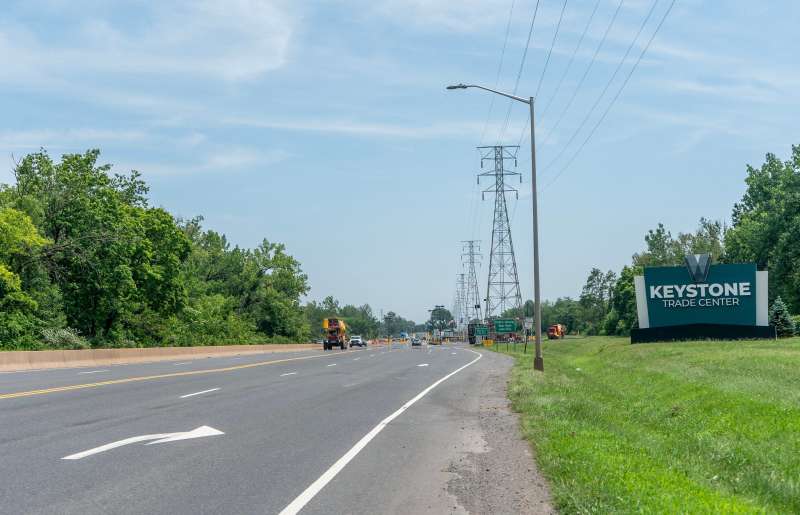
Amazon already has a massive data center under construction in the Keystone Trade Center in Falls that has generated loud opposition and resident concerns. The company plans to spend $1 billion for 10 buildings covering 3 million square feet within the former U.S. Steel industrial grounds.
Falls Township supervisors approved the center in 2025 and it is the only project currently approved in Bucks County.