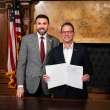
Pa. GOP Congressman Brian Fitzpatrick was among the lawmakers who spearheaded efforts in the House.
Members of Congress from both political parties are calling on the Trump administration to unfreeze funding for a grant program that helps local communities better prepare for natural disasters.
The letter from more than 80 lawmakers urges the Federal Emergency Management Agency to begin spending money already approved by Congress for the Building Resilient Infrastructure and Communities program.
“The BRIC program was established by Congress in the 2018 Disaster Recovery Reform Act and signed into law by President (Donald) Trump with bipartisan support,” the two-page letter states. “In the years since, this program has catalyzed community investments in resilient infrastructure, saving federal funds by investing in community preparedness before a disaster strikes.”
The lawmakers wrote that BRIC grant funds go to a variety of projects and that the program has played “an essential role in helping Tribal Nations and rural communities strengthen their defenses against natural disasters and safeguard critical infrastructure.”
“Through BRIC, Tribes and rural communities can access dedicated funding to strengthen community resilience by investing in hazard mitigation projects—such as flood protection, fire prevention, and infrastructure hardening—that are otherwise difficult to finance in rural or remote settings,” the lawmakers wrote.
While the program “has room for improvement,” the lawmakers wrote that FEMA and Congress should work together “to improve the application review and funding distribution process to more effectively reduce the costs disasters pose to our communities, economies, and livelihoods.”
Maryland Democratic Sen. Chris Van Hollen, North Carolina Republican Sen. Thom Tillis, Washington state Democratic Sen. Patty Murray and Alaska Republican Sen. Lisa Murkowski led drafting the letter in their chamber.
Reps. Chuck Edwards, R-N.C.; Sylvia Garcia, D-Texas; Brian Fitzpatrick, R-Pa.; and Ed Case, D-Hawaii, spearheaded efforts in the House.
‘Beyond reckless’
FEMA announced in early April that it would unilaterally cancel all BRIC funding approved from fiscal years 2020 through 2023, calling the program “wasteful and ineffective” in a statement.
“Approximately $882 million of funding from the Infrastructure Investment and Jobs Act will be returned to the U.S. Treasury or reapportioned by Congress in the next fiscal year,” a FEMA spokesperson wrote in the statement. “The 2021 law made $1 billion available for BRIC over five years, $133 million to date has been provided for about 450 applications. FEMA estimates more than $3.6 billion will remain in the Disaster Relief Fund to assist with disaster response and recovery for communities and survivors.”
The National Association of Counties wrote in a post about the cancellation that community leaders may “need to halt work or seek new funding sources” and “delay or scale back infrastructure investments.”
“Without access to BRIC’s federal match, counties may find it more difficult to pursue large-scale mitigation projects,” the NaCo post stated.
Association of State Floodplain Managers Executive Director Chad Berginnis wrote that dismantling the country’s “largest pre-disaster mitigation program is beyond reckless.”
“Cutting funding from projects already underway will leave states and communities scrambling, increasing disaster risk to families and businesses instead of reducing it,” Berginnis wrote. “The impact of this decision will be felt for decades to come.”