In 2023, the state-run Center for Rural Pennsylvania released the findings of what its then-director called “the most important research that we’ve conducted in recent years.”
That research: Projecting Pennsylvania’s population by 2050, which of its 67 counties will see growth and which of them will see loss.
The study found that the Keystone State’s population will remain stagnant, growing by only 200,000 people by the middle of the century. Only 21 counties will grow, the study found, while 46 will lose population. About 10 of those counties won’t see significant change in either direction. Urban areas, including in southeastern Pennsylvania around Philadelphia, will see the biggest gains, while rural areas will be hit hardest by low birth rates and a large aging population.
Now, the Center for Rural Pennsylvania says that, for some counties, its projections are becoming reality much faster than anticipated.
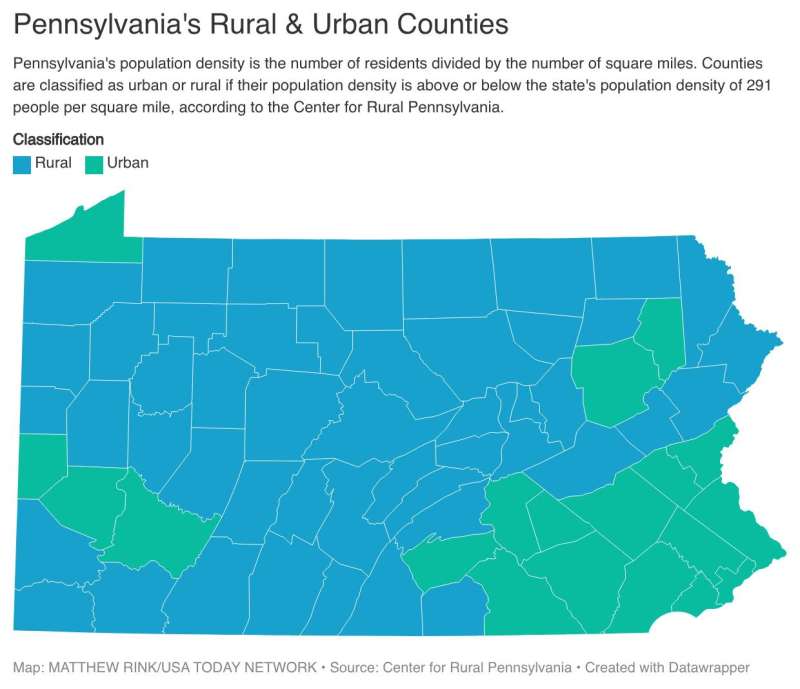
The state classifies 48 of Pennsylvania’s 67 counties as rural and another 19 as urban.
In its 2023 report, the Center for Rural Pennsylvania projected that all but two of the rural counties would lose population by 2050.
New census data
The original research was based off 2020 U.S. Census data. The Center for Rural Pennsylvania’s latest report is based off of 2025 Census estimates.
Center for Rural Pennsylvania’s Executive Director Zachary Adams said the 2025 census data is “special” because it offers the first glimpse at a five-year interval from the baseline data.
“What the 2025 Census estimates are showing us fall into a couple of different categories,” Adams told the USA Today Network-Pennsylvania. “First, for the majority of rural counties, populations are declining slightly faster than our modeling projected in 2023. Though on the whole, the modeling is within a statistical range, meaning that it’s still accurate.
“The other interesting finding from the 2025 estimate analysis is that migration continues to be the buffer for Pennsylvania in terms of our plateaued growth,” he said. “Across the commonwealth and in rural communities, migration is that buffer and, drilling down even further, domestic migration is actually greater in rural counties than in urban counties.”
Between 2024 and 2025, 37 counties saw their numbers decline, including 32 rural and five urban. And 25 of those counties ― all rural ― declined in population faster than the 2023 study projected.
In a new fact sheet published by the Center for Rural Pennsylvania, officials note that the minuscule uptick of 0.1% in the state’s overall population was due to “uneven population growth at the local level” and “growth concentrated within one or two municipalities inside their borders.”
“These shifts carry direct implications for the communities the General Assembly serves,” the report’s authors wrote. “School enrollment and funding, health care capacity, housing demand and infrastructure planning all depend on how many people live in a place and how old they are. Local planning may need to be revisited across the aforementioned policy areas where populations are declining faster than anticipated, including 25 of the 48 rural counties.”
As Adams noted, not all the news for rural counties was bad. An estimated 7,100 more people moved to a rural Pennsylvania county than moved out of one, while urban counties saw 10,000 more people leave than move in. These domestic migration figures include people who come from (or move to) other states or other counties.
“We are seeing that more folks, wherever they’re coming from outside of Pennsylvania, who live in one of the 50 states, are slightly more interested in moving to rural communities than urban ones,” he said.
County-focused
The Center for Rural Pennsylvania zeroed in on four counties to better understand the latest population figures. What it found was where, within some of these counties, the growth was concentrated. And in one instance, it also learned more about the demographic fueling one county’s uptick.
“Even in counties where there was growth, it’s typically seen in one to two municipalities,” Adams said. “For instance, Centre County grew but that was concentrated in one or two townships, particularly in the southern portion of the county. Then there are outlier rural counties that we profiled that I find really interesting. Both Cameron County and Greene County lost population at a faster rate than what our projections show, which is just something to continue to track. Pike County actually grew faster (than what it projected.)”
But much of that growth in Pike County is due to people over the age of 65 relocating there. That allows Pike to “realize short-term gains.”
However, “If you go back to the 2023 analysis, they’re actually projected to decline and that tracks because older adults aren’t necessarily going to be living through 2050. So even in some of these areas where perhaps they’re showing larger growth than what our projections modeled, it’s typically due to either sensitivities with having a smaller population or in the case of Pike County, the growth is being driven by older adults who won’t necessarily be with us in 2050.”
More housing
The Center for Rural Pennsylvania found that nearly every county, even if their population is declining, saw an increase in newly available housing units, which it determined through the issuance of building permits.
“It appears that, at least from a building permit perspective, counties are responding to the housing issue,” Adams said, “and as a result we’re starting to see more housing stock across the commonwealth.”
Southcentral Pennsylvania, from Franklin to York counties and up through Perry County, is seeing the greatest positive percent change in new housing units, he added. Only two counties, Cameron and Jefferson, did not see growth in the number of housing units in 2025.