For the third year in a row, the annual state budget included provisions that sent additional dollars to a handful of school districts, outside of the typical funding formulas that govern state support for the 500 public school districts.
And for the third year in a row, all of those districts are represented by Democrats in the state House.
Collectively, four school districts are set to receive $8 million in the 2026-2027 school year, on top of what they receive through the commonwealth’s basic education formula and newer adequacy formula.
That’s on top of $5 million that went to a school district represented by House Speaker Joanna McClinton (D-Philadelphia) last year, and a tweak to the adequacy formula that sent $14 million to 11 school districts in the 2024-2025 budget.
But the four districts all faced unique financial challenges. Democratic lawmakers who sought the funding bumps in the latest budget say it was a product of those needs and their advocacy, not partisan favoritism.
A spokesperson for House Democrats did not respond to requests for comment.
When asked whether he advocated for similar funding bumps for struggling school districts represented by Republicans, House Minority Leader Jesse Topper (R-Bedford) told the Capital-Star “that’s not something that we normally look at.”
“There are always those kind of provisions that are inserted [in the budget],” he continued. “That’s not something I want to see. I want to redo the entire way we fund education and the adequacy formula. I’m not thrilled with any of them.”
The repeated inclusion of additional funds for certain districts raises questions about the effectiveness of Pennsylvania’s formulas for funding its public schools, and about whether all parts of the state are able to access additional funds when necessary.
“I don’t think that there is a perfect formula out there that fits all,” said Edward Albert, the executive director of the Pennsylvania Association of Rural and Small School Districts.
While he praised the additional funding some schools have received through the new adequacy formula — the result of a 2023 court decision that found Pennsylvania’s school funding formula was unconstitutionally inequitable — he acknowledged that there are some district leaders who have felt left behind by it.
“We’re rejoicing this year with what we got in the budget, but I have superintendents emailing me saying, ‘I didn’t get anything,’” he said.
But Albert doesn’t see the apparent partisan divide over which school districts are receiving supplemental funding as necessarily a show of favoritism, even if the rural school districts he works with are more likely to be represented by Republicans.
“If you’re just looking at the bigger picture from 30,000 feet up, Democrats are obviously gonna want more money, and obviously Republicans are a little more conservative,” he said. “The whole thing is not black and white.”
Difficult decisions
The Muhlenberg School District in Berks County faced a $2 million budget shortfall in the 2025-2026 school year, leading officials to mull staff cuts and a property tax hike.
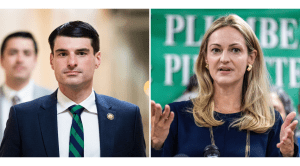
In this year’s state budget, the district represented by Rep. Jacklyn Rusnock (D-Berks) received $2.5 million in additional funds, on top of what it was set to receive from the basic education funding formula and the newer adequacy formula.
“Muhlenberg is the fastest growing school district in Berks County, “Rusnock said. “It’s growing exponentially faster than every other district.”
According to Rusnock, that’s caused a unique financial strain that the school funding formula is not adept at keeping up with. So she went to legislative leaders and asked for help.
“The way I look at it, we’re bringing in additional funding that focuses on the district’s needs, and it’s also not placing an additional burden on the local taxpayers,” she said. “This is something that I’ve been working with leadership on since December.”
Asked about why she thinks only school districts represented by House Democrats have received additional funding outside the formulas in recent years, she said it wasn’t something she’d considered.
“I didn’t realize that had happened,” she said. “I can only speak for myself. I am an advocate of public education. I’m a product of education. I taught in the public education system. I just think it’s really important our school districts are getting what they need … I really can’t speak to why it would be a Democrat or Republican issue.”
The Steelton-Highspire School District in the Harrisburg area in Dauphin County faced a $4.5 million budget shortfall, leading to discussions about cutting dozens of staff. Along with basic education and adequacy funding, Steelton-Highspire will receive $1 million in additional funding after lawmakers pushed for more help.
According to Rep. Dave Madsen (D-Dauphin), who represents the district, the idling of the Cleveland Cliffs steel mill in Steelton, which employed roughly 500 people, strained the community’s tax base. As it stands, it’s not clear what can replace the hundred of lost jobs or the business itself.
“It is a very unique situation when you have such a small population that has the conditions they have in terms of their tax base,” he said. “I don’t see how they could overcome it without some sort of additional help, and that was the case I made to leadership.”
Asked if he thought partisanship played into Steelton-Highspire being awarded money outside the typical school funding formulas, Madsen couldn’t say.
“I advocate for my district, and I know other colleagues, both Republican and Democrat, have similar circumstances. What their conversations with leadership look like, I’m not privy to. I just know with the ones that I had, working with my school district, we just laid out a case for why we would need additional help.”
The Morrisville-Borough School District in Bucks County is set to get $3.5 million in the 2026-2027 school year outside the typical funding formulas.
Rep. Jim Prokopiak (D-Bucks) described issues not entirely dissimilar from those Steelton-Highspire faced.
“Fifty years ago, there was a lot of industry that was attached to the school district. As industries eroded, the tax bases eroded,” he said. “The money for Morrisville this year was correcting a problem that had been decades in the making.”
Years of funding struggles led the school district to take on debt.
Asked about the political tilt of the awards, Prokopiak pointed to issues that have primarily affected suburban and urban school districts, which are more likely to be represented by Democrats.
Pennsylvania has a school funding policy known as hold harmless, which ensures that, even if student population declines, schools continue to receive the same amount of money from the state that they did the year before.
“I don’t think it’s a party situation. I think it’s more demographic changes,” Prokopiak said. “Rural school districts have traditionally, because of the population decreases in those areas, actually gotten more funding than they necessarily would under a new formula. Many counties in Pennsylvania are shrinking, but they still maintain their same funding formula. Areas that are growing tend to be more in the suburban areas, which recently have tended to be more represented by Democrats than Republicans.”
The Whitehall-Coplay School District in Lehigh County is also set to receive $1 million, but Rep. Jeanne McNeill (D-Lehigh), who represents it, did not respond to a request for comment from the Capital-Star.
Like the other school districts, it faced a multimillion dollar budget deficit and officials mulled difficult decisions like whether to cut staff.
How it’s played out in recent years
Last year only one district, the William Penn school fistrict in Delaware County, received an additional funding bump. It had struggled financially for years and was one of six named plaintiffs in the adequacy funding lawsuit – which led to a new formula being created in 2024.
William Penn is in House Speaker McClinton’s district.
At the time, a spokesperson for House Democrats told the Capital-Star, “the guiding principle for the House Democratic caucus has always been and always will be to help the least advantaged. There is an overlap to the extent that our leaders represent some of the poorest areas. Maybe that is a good thing.”
During negotiations over the 2024-2025 state budget, 11 school districts were singled out to receive annual budget bumps of $14 million collectively, including William Penn and Steelton-Highspire.
Like all the five school districts that received supplemental funding in the 2025-2026 and 2026-2027 budget, all 11 were all represented by Democrats in the state House.
But lawmakers and experts told the Capital-Star that year that the selection of schools in Democratic lawmakers’ districts was the result of tense negotiations over the creation of the adequacy formula.
When creating the new adequacy formula to address the school funding lawsuit, lawmakers in both parties knew that it needed to increase funding for school districts in impoverished areas. But there was disagreement over how that should be measured.
Democrats advocated for a formula that would measure local poverty based on figures collected by school districts themselves. They argued those numbers were the most accurate available since the district staff collecting them regularly interacted with, and were likely to be trusted by, impacted families.
Republicans preferred data collected in annual surveys by the U.S. Census Bureau, arguing that school districts may be incentivized to meddle with data that would affect their own funding.
It was a fight that Republicans ultimately won. But that meant dozens of school districts receiving less funding than they would have under the Democrat-backed plan.
The additional funding for 11 school districts was a way to bridge that gap for some of those most affected by the change. They were also represented by Democratic lawmakers who plead for additional help ahead of an expectedly close vote over the implementation of the adequacy formula.
Albert, the executive director of the Pennsylvania Association of Rural and Small School Districts, suggests one way lawmakers could help districts that fall under unique strain would be to build funding for them into the budget.
“Maybe there’s a pool of money put off to the side to kind of offset those to make it right,” he said.
The hope is that the funding being readily available would make lawmakers of both parties more willing to advocate for it reaching school districts they represent.
Albert also advocated for increased transparency and accountability measures to ensure that school districts are using state funding to boost educational outcomes. He hopes that would make lawmakers less reticent to provide additional funding for struggling school districts.
“I’m a firm believer in accountability. I think when we’re asking for money, I think it’s very important for us to say, ‘here’s what we’re using the money for.’ … But that’s a two way street. I think legislators should want to come to schools.”