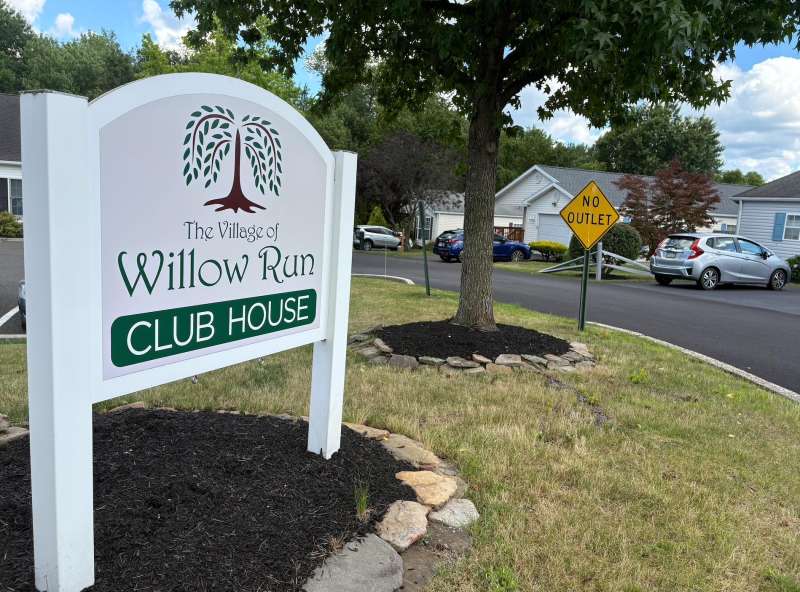
Moving boxes were still stacked throughout the tidy, black-shuttered home that Dennis and Susan Johnson had bought in Montgomery County when a landscaper alerted them that their lot rent was about to go through the roof.
The couple had spent three years scouring the housing market for the right combination of affordability and proximity to their children and grandchildren. After looking at an array of condominiums and single-family homes, they concluded the best option was to buy a Mount Airy manufactured home in a 55-plus community called Village of Willow Run.
Though the house is theirs, the dirt beneath it is not, belonging instead to a real estate company that also owns a portfolio of strip malls and apartment complexes. According to the document the Johnsons signed on closing day, they were supposed to rent that ground at a rate of $615 per month.
Only, a few days later, the couple learned the monthly fee was jumping to $925, a 50.4% increase.
“I never in 54 years saw my husband go so white,” Susan Johnson, a retired educator, said.
The couple had lived in manufactured home communities before and expected their lot rent to creep up over time, perhaps by 5% or 10% annually. They weren’t prepared for it to spike by half in a single year.
Now, they’re partnering with their neighbors and residents of manufactured home communities around Pennsylvania to press for a law that would protect them from sharp rent hikes. Though the Willow Run owner has local ties, many of these reformers say large, out-of-state companies are snapping up these communities expressly to pump up rates for residents who would struggle to relocate.
These stiff and sometimes unpredictable rent increases are threatening the stability of such housing even as the commonwealth searches for more affordable, single-level options for a growing population of older adults, the advocates say.
At Willow Run, Dennis Johnson said, many living in the 148-home neighborhood are in their 80s or are disabled veterans.
Pennsylvania Rep. Dan Moul, a Republican lawmaker who operates one of these sites, said he generally recognizes property owners’ right to make money. But he sees these situations as akin to illegal price gouging.
“There’s a difference between making a reasonable profit and gouging people when they have nowhere to go,” he said.
Other property owners say a bill to limit rent increases would tie their hands as they seek to care for these communities and keep up with their own climbing costs.
Jared Surnamer, whose family owns 11 manufactured housing communities in the Allentown area, acknowledges that some lot rent jumps can seem shocking.
But he believes policymakers should target systemic problems that are driving some of these issues, such as local zoning policies that squeeze out affordable housing projects.
“When the supply is fixed, it’s going to increase the cost,” Surnamer said. “And it’s also going to attract investors or businesspeople who see this is a valuable asset.”
A home for aging in place
Demographers estimate that by 2030, one in three Pennsylvanians will be age 60 or older and outnumber every other age group in the commonwealth. State officials have made it a priority to expand affordable housing options so older adults can age where they choose, with the support they need.
Manufactured housing is one relatively simple solution, as long as owners have a place to put their homes and feel secure that their lot rents won’t spiral out of hand, says Bob Besecker, a Berks County advocate.
Already, communities with manufactured homes skew older than the rest of the commonwealth, according to an analysis by the Federal Reserve Bank of Philadelphia.
Besecker and his wife moved out of their two-story colonial house, where he had to tend the lawn and chop wood for the stove, because these tasks had gotten increasingly burdensome as he aged. It made sense to shift into a single-level manufactured home with a yard that property managers mowed for him, he said.
“When people move into these, in the 55-plus range, we look at it as our last true shot at independent living,” said Besecker, who founded the Coalition of Manufactured Home Communities of Pennsylvania. “So it’s really, really important and meaningful to us.”
At one time, advocates say, local ownership had kept rate hikes in check, since mom-and-pop landlords often knew the residents in their communities and had to look them in the eye after raising rents.
Several years ago, an out-of-state company bought Besecker’s Berks County community, and he said his lot fees have climbed by more than $300 per month since then.
Moul, who owns a manufactured home community in Adams County, said private equity firms have offered to buy his property for sums that far exceed its value. They’re willing to pay these high prices, he believes, because they want to jack up the rates as soon as the sale goes through.
Moul said he can’t stomach the idea of doing that to longtime residents in the 36-home development.
“These are people that, most of them have been with me since Day One, and now most of them are older,” the Republican lawmaker said. “So for me to sell out to a private equity firm that’s gonna do nothing but screw them to the wall, I just couldn’t sleep at night.”
How mobile are Pennsylvania ‘mobile homes?’
Moul says that, in general, rent-control measures are anathema to Pennsylvania policymakers.
But manufactured home advocates believe there’s a compelling argument for distinguishing their communities from apartments or other rentals.
While these dwellings were once dubbed mobile homes, their design has changed over the years and they’re now built to stay put, Besecker says. Many owners add garages, decks or other structures.
Relocating these homes can cost anywhere from several thousand dollars to more than $20,000, according to Forbes.
So although Moul is generally uncomfortable with capping rental fees, he’s supporting a proposal to limit lot rent jumps to 4% or the Consumer Price Index, whichever is lower. That bill, HB1250, has passed the House of Representatives and is stalled in the Senate.
The measure does have a provision enabling property owners to exceed the rent cap in some cases but would require them to justify the rate change and would empower residents to challenge these decisions.
Gov. Josh Shapiro has urged state legislators to approve the measure. If they don’t do so by the end of 2026, the bill will die in the General Assembly, and advocates will have to start the legislative process all over again.
Representatives of community owners hope it does falter, arguing that curbing fees could impair their ability to maintain these neighborhoods.
Moul acknowledges that increasing taxes and upkeep costs have required him to raise lot rents over the years. However, these gradual shifts don’t explain the dramatic lot rent hikes that some parks are imposing, according to the representative, who says he charges $500 a month.
But Mary Gaiski, executive vice president of the Pennsylvania Manufactured Housing Association, said property owners are dealing with a bevy of cost pressures, including insurance rates and maintenance and compliance projects. In communities where the rent includes utilities, soaring power and water bills also push rates up.
The possibility of a legal rent cap has also weighed on landlords’ minds as they’ve been setting monthly fees recently, she said. Some have considered making increases while they still can, worrying they might have less flexibility to adapt to financial challenges in the future, she said.
If the legislation goes through, she contends, communities will be at greater risk of falling into disrepair and losing amenities as owners struggle to pay their bills.
Surnamer said he maintains wastewater treatment plants and well water systems for his properties, and a few of them recently needed upgrades that cost several hundred thousand dollars apiece. Property insurance rates have also skyrocketed recently, he says, and he also wants to keep offering his employees competitive wages and solid healthcare plans.
He and Gaiski each say the more fundamental problem is the lack of housing affordability, an issue that manufactured home communities could help solve if local officials relaxed their zoning laws — or if state leaders forced their hand.
How hot is your Pennsylvania housing market? Explore the state in this interactive graphic.
Fixed incomes, rising costs
After the 2025 rent hike notification, Dennis Johnson filed a complaint with the Pennsylvania Attorney General’s Office, claiming that his landlords — driven by “corporate greed” — had gone overboard.
In response, the property owners contended that their monthly rates have long lagged behind what similar communities charge, arguing the increase simply brings their rents up to par. An attorney for the property owners compiled a list of a few manufactured home parks they say charge similar fees, although Dennis Johnson disagrees that they’re comparable with Willow Run.
“The fact that Limerick’s residents benefited for many years with relatively small rent increases does not mean that the current rent increase is unreasonable or in violation of any consumer protection concepts,” the company’s attorneys wrote in a response to Johnson’s filing.
Dennis Johnson said the attorney general’s office opted against moving forward with his complaint. Still, because he and his wife locked in their $615 rent for a year in their home purchase agreement, they won’t have to deal with the increase until September.
Other community members have already been paying the higher rate for months.
Damyon Verbo, 75, said he’d always thought communities like his were designed to support older adults as they age. He and his wife have managed to absorb their higher lot fees so far, but he worries that if one of them dies in the years to come, the remaining spouse will struggle to stay in their home.
Sandy Ponticello, who has lived in the community for more than three years, said when she first saw her landlords’ letter about the $300-per-month rent increase, she thought it was a typo.
“It’s not like they were giving us anything in return,” said Ponticello, 65, who lives on her monthly Social Security check.
Ponticello said she appreciates that property managers have extended a rebate to offset her cost increase over the first year. But she’ll start paying the full amount in the next couple months and can no longer afford to replace her 20-year-old car.
In light of the climbing costs, Dennis Johnson, who spent his career in the steel industry, said he’s thought of exiting the state and buying something cheaper in South Carolina, though he and his wife would hate to live so far from their four children and 13 grandchildren.
So they feel locked into Pennsylvania, their home state. In the next few weeks, a yearly rent letter should land in their mailboxes, letting them know how much it will cost them to remain rooted.