Last June, Gov. Josh Shapiro made a speech in Berwick, on the border of Luzerne and Columbia counties, to celebrate what he called the “largest private sector investment in the history of the commonwealth.”
Amazon was investing at least $20 billion to develop a pair of large data center campuses in Pennsylvania, with the prospect of more to come.
Standing with high-ups at Amazon, Republican U.S. Sen. Dave McCormick, and state and local officials, Shapiro spoke of the investment in epochal terms.
“Right now, there is a battle for supremacy when it comes to AI, a battle that will be won by either the United States or China,” he said. “I sure as hell think those technologies should be developed by the hands of a Pennsylvania worker here in the United States of America. Not in communist China.”
As he put it, his administration was “all in on AI.”
Republican state Treasurer Stacy Garrity, who at the time was already considered a frontrunner to challenge Shapiro for his seat in 2026, called the investment “great news” on the social media platform X.
“This will not only bring historic investment into our commonwealth but also create thousands of jobs for Pennsylvanians,” she wrote.
But with Shapiro and Garrity now squaring off in the November gubernatorial election, they’re appealing to a public that has grown increasingly wary of data centers.
In recent appearances, Garrity has called for a total pause on new data center development until state leaders can address the concerns of local officials and community members.
Shapiro says he wants “strict guardrails” to protect communities, utility customers and the environment from the worst impacts of data center development.
While both have changed their tone in the year since the Amazon deal was announced, they’re accusing one another of hypocrisy.
“Stacy Garrity is a desperate politician – and her long record of supporting completely unregulated data center development makes it clear that she just can’t be trusted,” Shapiro campaign spokesperson Manuel Bonder said in a statement to the Capital-Star.
At an event in Cumberland County earlier this month, Garrity told a crowd of reporters that “we all know that the governor was the biggest cheerleader of data center development in Pennsylvania until he wasn’t.”
“It is a huge, massive flip-flop, and nobody should be fooled,” she added.
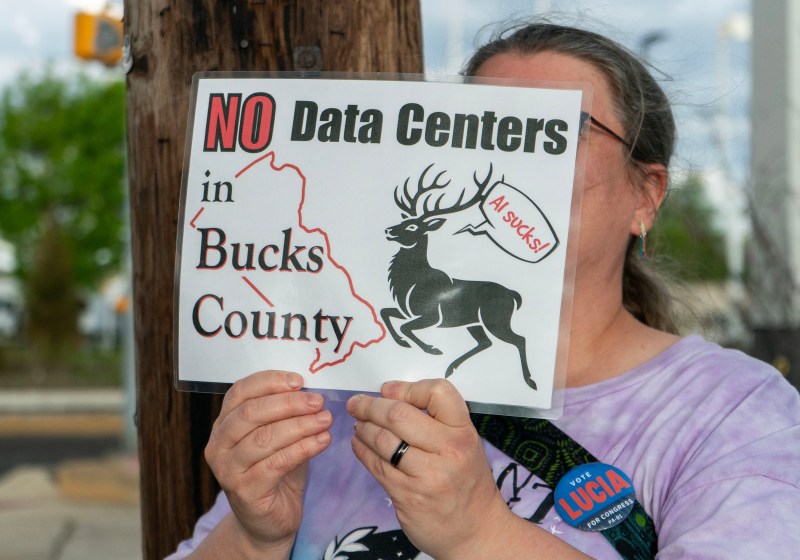
The fight over data centers by Pennsylvania’s gubernatorial candidates reflects voters’ growing distrust of artificial intelligence, big tech, and developments themselves.
An Emerson College survey taken in December, 2025, shows that Pennsylvanians are worried.
Seventy-one percent of respondents said they are concerned about the amount of power data centers use. And while respondents were more likely to say data centers will have positive effects on jobs and the economy than negative, they were also more likely to say they’d have negative impacts on the environment and cost of living than positive ones.
Its findings reveal Pennsylvanians are also sour on artificial intelligence. Forty-eight percent believe it will have a negative impact on the economy, compared to 25% who believe it will be positive. Similarly, more than double the number of respondents think it will have a negative impact on the environment compared to positive.
What the candidates are proposing
With the governor’s race picking up, Shapiro and Garrity have both laid out, at least in part, a vision for what data center development should look like in Pennsylvania.
Garrity has said, if she wins office, she plans to call for a pause on new data center development until she can work with local officials to develop clear guidelines that will protect communities from potentially harmful impacts.
Data centers can require hundreds of thousands of gallons of water daily to operate. They can also put large strains on local power grids and boost costs for other utility customers. Local officials have also raised concerns about the strain on local resources, from fire departments to police retraining to handle issues in the highly specialized centers. And they can cause noise pollution that has led residential neighbors to sue several data centers across the country.
Garrity, however, has provided few details. And it’s unclear if she could institute the pause without legislative approval, though she’s said she believes it would be within her power.
“We pause for as long as we need the pause,” she told reporters. “Before we do anything new, we really need to get clarification, we really need to make sure that townships have the opportunity to update their zoning.”
She’s also called for data center development to be restricted to brownfield and industrial sites.
“We have a ton of those sites,” she said. “It should not be residential areas, because what I hear is, ‘Not in my backyard.’”
Shapiro, for his part, has pushed the legislature to pass laws enshrining what he’s called the Governor’s Responsible Infrastructure Development (GRID) standards, a new set of rules his administration created for data center developers.
While optional, they would require developers to meet benchmarks on transparency, environmental protection, and energy sustainability if they want state assistance like tax breaks and fast-tracked permitting.
Data center developers would have to commit to getting one-third of their energy from renewable sources by 2035, and either generate their own power or pay for energy infrastructure they would require to operate. If a project is larger than 100,000 square feet, developers must make sure their roofs are “solar ready,” meaning they’re retrofitted for solar panels, even if they have none.
They would also be required to hold public meetings, notify local governments about their proposed data centers’ size, peak electric demand, and annual water consumption. And they’d be mandated to develop community benefit agreements with local governments, covering subjects like potential noise pollution, light emission and traffic that their projects would create.
On the labor front, they would have to commit to creating at least 200 new prevailing wage construction jobs, come up with hiring plans encouraging local workforce participation, and make $250 million in community investments.
“Governor Shapiro has worked directly with community, labor, and environmental leaders to develop and propose some of the strongest data center regulations and standards of accountability in the entire country,” Bonder, Shapiro’s campaign spokesperson, said in a statement to the Capital-Star.
But the guidelines are optional. Data center development that doesn’t meet those standards would still be allowed according to local zoning laws, but developers would lose access to sales tax cuts on computer equipment and fast-tracked permitting that can save months on their project planning.
The plan has drawn mixed reactions from environmental, tech and labor groups. Charles McPhedran, the senior attorney at EarthJustice, a non-profit focused on environmental protection, told the Capital-Star that he’s worried even the optional provisions may prove difficult to effectively enforce.
Megan McDonough, state director for Food and Water Watch Pennsylvania, told the Capital-Star in May that the plan “reads like a Big Tech wish list.”
“This plan is an admittance that Pennsylvania has a data center problem — but this is no solution,” she added.
Dan Diorio, the vice president of state policy with the Data Center Coalition, said his group appreciates Shapiro’s “leadership and attention to the significant role data centers can play in Pennsylvania’s economic future,” but has concerns about the GRID standards.
“DCC has strong concerns that Governor Shapiro’s GRID proposal creates a complicated framework that would present significant challenges for future development and operation of data centers in the commonwealth,” his statement read. “It is fair to ask why this industry — which is central to modern life, economic growth, national security, cloud computing, cybersecurity, and our broader digital culture — would be held to a set of standards and requirements that are not similarly applied to other major energy users, large-scale industries, or economic development projects.”
On the other hand, the Conservation Voters of Pennsylvania said Shapiro’s proposal marks “a step in the right direction to protect Pennsylvanians by establishing clear metrics around energy affordability, environmental protection, community engagement, and workforce development. These standards recognize that we cannot allow Big Tech to threaten our environment or our financial stability.”
So did they flip-flop?
Garrity has pushed back on the notion that she’s ever changed her tune when it comes to data centers.
“I know there was some headline and you guys want to infer that my position has ‘evolved,’ but it hasn’t,” Garrity told reporters earlier this month. “I’ve always said you can’t jam these things down the throats of communities. I’ve said that from day one.”
But in earlier interviews, Garrity focused on deregulating and expanding development when asked about the subject.
Last summer, Garrity told Larry Richert on KDKA’s Big K Morning Show that Pennsylvania was “playing around the fringes” compared to other states on data centers, noting that Ohio had more than twice as many.
“We need to deregulate,” she said. “Pennsylvania is not an easy state to do business in and our neighbors are kind of eating our lunch.”
In July, she told Breitbart that Pennsylvania needed to increase energy production to fuel “a rebirth of Pennsylvania as a national AI and tech hub.”
It’s a starkly different tone than she’s striking as a gubernatorial candidate.
Pressed on that by reporters, Garrity said she’s learned a lot in the time since, and when she was strictly acting as treasurer, her goal was shrinking the state’s deficit.
Shapiro’s campaign did not directly respond to questions from the Capital-Star about Garrity’s accusation of hypocrisy.
The governor spoke in glowing terms about the economic possibilities of data center development leading up to the Amazon announcement, and while rolling out his “lighting plan” early last year to boost energy production in the state.
While his comments have continued that line, in more recent speeches he’s also sought to center the concerns of Pennsylvanians who may not want data centers near their communities.
He attempted that balance in his February budget address, for example, where he laid out his GRID standards. Shapiro called on Pennsylvania to lead in data center development, but to “be selective about the projects that get built here.”
“I know Pennsylvanians have real concerns about these data centers and the impact they could have on our communities, our utility bills, and our environment, and so do I,” he said, while reiterating the importance of America’s battle for AI dominance over China.
“We can play a leading role in winning the battle for AI supremacy — but we have to do it in a way that puts the good people of Pennsylvania first,” he added.
Berwood Yost, the director of the Center for Opinion Research at Franklin & Marshall College is not entirely surprised that the issue has become central to the early stage of the gubernatorial campaign. Not only has it hit many voters in their communities, but he believes it may be representative of something larger.
“If we’re putting all of this together, I think there’s real opposition to data centers,” he said. “But I think that’s symbolic or emblematic of deeper concerns about technology in general.”
He pointed to polling showing strong opposition to artificial intelligence, and even cellphones in schools, that crosses party lines.
When it comes to the candidates’ platforms, Yost also noted, “at least substantively, there’s not a huge difference in what they are suggesting. She’s calling for a moratorium and he’s calling for more local input and standards about how they’re developed. But essentially they’re both trying to say that we need to do something to ensure these are developed properly with community input.”
To Yost, that indicates the way Shapiro and Garrity talk about data centers may have more to do with how they’re trying to portray themselves and each other to voters.
“By saying that she’s proposing a moratorium, she’s probably also making the case that Shapiro is more in line with the tech industry than she is, which would be a popular position” Yost said about Garrity.
And for Shapiro, Yost noted that he’s portrayed himself as a politician who can work with competing parties to reach practical solutions.
His GRID proposal has drawn the ire of both environmental advocates and data center developers. Garrity said it was emblematic of “want[ing] to be all things to all people.” But to Yost, it’s telling voters that he can be trusted to find a “balanced, pragmatic approach” to a complicated problem.
“I do think people – voters that is – are looking more at solutions that are workable than sort of staking out ideologically positions that don’t solve their problems,” he said.
But that approach can come with a cost.
Last week, dozens of people attended an hour-long rally at the Capitol, criticizing Shapiro of being too cozy with the tech industry, and comparing data center development to extrapolative practices like fracking.
“There’s Republicans and Democrats standing side-by-side on this,” Sam Burleigh, from Montour County, said about the coming elections up and down the ballot. “Whoever wants to stand with the people and stop these things — or at least slow them down so that people can get ahead of them — they’re going to be the ones that are in the limelight.”