An unvaccinated Centre County resident has died after testing positive for measles, the Pennsylvania Department of Health announced Monday. It’s the state’s ninth measles-related death in 2026.
The announcement comes less than a week after the US lost its measles-free status, as the highly contagious virus once relegated to medical textbooks has spread—largely among the unvaccinated—at the highest rate in more than 30 years.
Measles was declared eliminated in the US in 2000.
Pennsylvania’s measles outbreak is the worst in the US. Although measles rates have declined from their September peak, the commonwealth still accounts for nearly 30% of all cases in the US, and some doctors expect them to rise again as winter brings more indoor gatherings.
The state Department of Health has confirmed 1,638 measles cases in 46 of Pennsylvania’s 67 counties, including 80 new cases reported over the last week. At least 330 people have been hospitalized, and just five confirmed cases (less than 1%) have involved vaccinated individuals.
According to a report from WESA, adults account for two-thirds of those cases.
The numbers represent a dramatic increase from previous years. Pennsylvania recorded just 16 measles cases in 2025 and six in 2024.
Pennsylvania’s first two measles-related deaths in 35 years were reported in August, involving infants in Lancaster County. County Coroner Stephen Diamantoni, an elected Republican, initially cast uncertainty on the cause of death before confirming that the virus itself caused one of them. After Gov. Josh Shapiro traveled there to announce the deaths, Diamantoni claimed that state health officials never attempted to consult him regarding the cases. But according to a
report from The Philadelphia Inquirer, emails show that they did, repeatedly.
According to the health department, Lancaster County has the most confirmed measles cases
with 558, followed by Mifflin (205) and Jefferson (114) counties.
Nationally, South Carolina has recorded the second-most cases of measles with 670, followed
by Wisconsin with 657, and Utah with 536, according to the Centers for Disease Control and Prevention (CDC).
Shapiro has clashed publicly with US Health Secretary Robert F. Kennedy Jr., a
Trump administration appointee with a history of raising alarms about established vaccines, over
misinformation and his decision to change childhood vaccine schedules—something
many doctors, healthcare experts, and government officials disagree with.
While speaking in September at a conference of an anti-vaccine activist group he once chaired,
Kennedy told the hundreds in attendance that they had a friend in President Donald Trump’s
White House.
Contagious virus is a rising threat to everyone
Measles is one of the most contagious infectious diseases. The virus spreads easily through air when an infected person breathes, coughs or sneezes. It can also be transmitted by touching contaminated surfaces.
On average, symptoms appear between one and two weeks after exposure, but they can take up to three weeks to develop.
“Measles is really the lion king of infectious diseases when it comes to transmission,” said
Michael Osterholm, who directs the University of Minnesota’s Center for Infectious Disease
Research and Policy. “No one in the United States of America who is susceptible to the measles
virus, either having not been vaccinated or not having previously had it, should feel safe from
measles. No one.”
The risk grows as vaccination rates decline.
According to the CDC, 92.4% of US kindergarteners in 2025-26 received the required MMR
shots. That’s down from 95.2% in 2019-20.
Pennsylvania’s MMR (measles, mumps, and rubella) vaccination rate among kindergarten
students is 93.2% for the current school year, down from 96.4% in 2018-19 according to data
from the Pennsylvania Department of Health School Immunization Rates.
How can Pennsylvanians protect themselves from measles?
Vaccination remains the state’s primary recommendation.
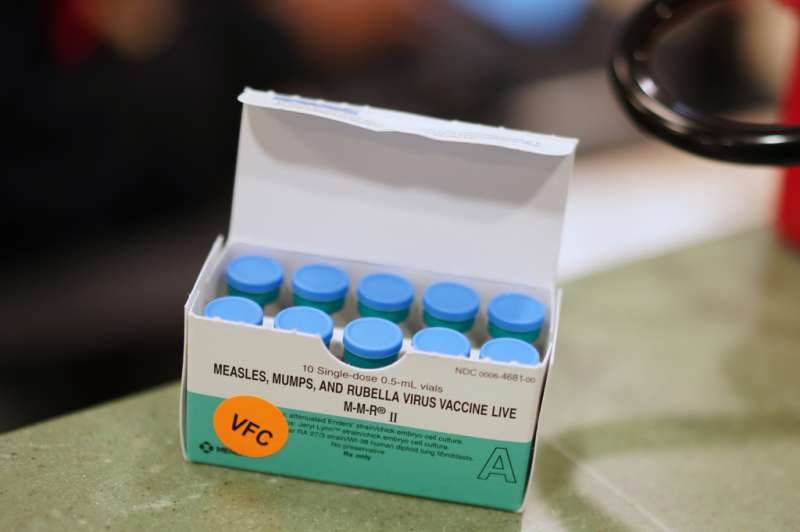
Pennsylvania health officials say the two-dose MMR vaccine provides 97% lifetime protection
against measles. People with two documented doses don’t need another dose, while adults with
only one dose or who can’t locate their vaccination records should talk with a healthcare
provider or pharmacist.
Vaccination demand has risen during the outbreak. Pennsylvania providers typically administer
about 25,000 MMR doses per month, but more than 56,000 doses were administered in
September and more than 53,000 during the first four weeks of October, according to the state.
Residents who believe they were exposed to measles and are experiencing symptoms should
contact their health care provider or call the state health hotline at 877-PA-HEALTH.
Information from the Associated Press was used in this report.