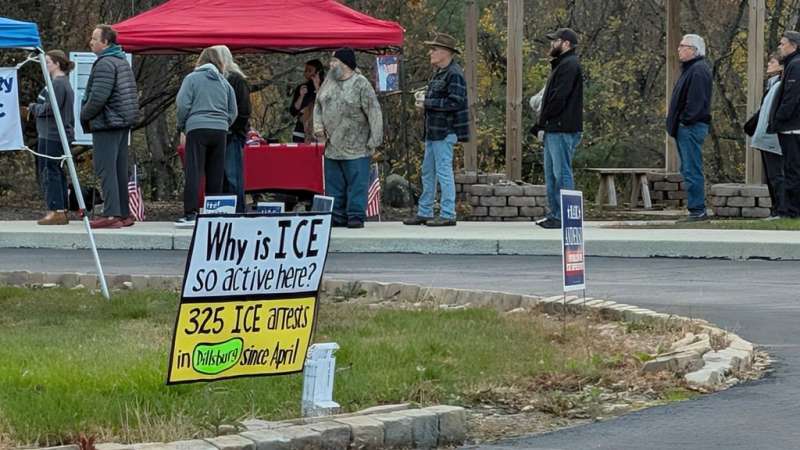
York County leads the state in the number of illegal immigrants detained under what’s known as 287(g) agreements between local police departments and U.S. Immigration and Customs Enforcement.
The data, gleaned from ICE reports obtained by immigration advocacy groups, shows that York County, despite accounting for a mere 3.6 percent of the state’s population, accounts for more than 31 percent of the arrests made under the agreements between local law enforcement and the federal government.
That might not exactly be accurate.
Analysts say the ICE statistics could underreport the number of arrests and detentions.
The numbers show that local law enforcement has been driving a spike in immigration arrests in York County this year and that as many as three-quarters of those detained by ICE as a result of agreements with local police agencies do not have criminal records, contrary to the assertion by federal authorities that the program is intended to keep communities safe from violent offenders described as “the worst of the worst.”
While more high-profile cases — such as the arrests of a local pastor, a youth soccer coach and the husband of a woman who runs a cat rescue who has been in the U.S. for nearly 26 years — have attracted a lot of attention, experts believe there are many others whose cases have escaped public scrutiny.
Data issues
However, these numbers provided by ICE are not very reliable, either through design, bureaucratic complexities or sheer negligence, according to Andrew Thrasher, a Chicago-based consultant to immigration law firms and advocacy groups.
“The way ICE reports the arrests and the way they’re logging it” is problematic, he said.
Thrasher suspects the numbers reported by ICE are low, underreported either by negligence or purposely to protect local departments from backlash from taxpayers concerned that their police officers are dedicating time apprehending and deporting pastors, landscapers, construction workers and people who work in poultry processing plants rather than addressing serious crimes.
ICE’s public affairs office did not respond to an email seeking comment.
The data, originally obtained by the Deportation Data Project via a Freedom of Information Act request, “likely represents an undercount of the actual number of arrests” that can be attributed to 287(g) agreements, Thrasher said.
For one thing, he said, the way ICE reports data makes it difficult to parse which police departments had detained immigrants and handed them over to the federal agency. “The way ICE publishes the data does not attribute each arrest to any particular police department,” he said.
ICE reports 287(g) detentions by municipality, making it difficult in some cases to attribute a specific arrest to a certain police department. For example, it’s possible that arrests made in what ICE describes as “York” were made in suburbs that have York postal addresses.
Further complicating matters is the seeming haphazard way the data is reported, Thrasher said.
“A lot of my work is cleaning up typos and trying to figure out what they actually meant,” he said. “While I’ve tried to clean up glaring mistakes, the data is notably low quality.”
Thrasher has encountered instances in which the name of the municipality reporting an arrest is misspelled and not included in that jurisdiction’s total.
And it’s also difficult to determine which police departments are being more aggressive in enforcing immigration laws, Thrasher said. “Where ICE says 100 people were arrested in West York, that doesn’t necessarily mean that the 100 arrests can be attributed to the West York Police Department,” he said. “There could be overlapping jurisdictions.”
High-profile York County cases
The agreements have attracted attention recently because of several stories about immigrants being detained by local police departments for minor traffic violations and taken into ICE custody in detention facilities or deported.
The recent case of Molis Agustave, a pastor and organizer with the local chapter of the immigration advocacy group We Are CASA, illustrated that. Augustave, a Haitian immigrant who is married to a U.S. citizen and has no criminal record, was deported in September after being stopped by West Manchester Township Police for a burned-out headlight.
Another Haitian immigrant, Amson Charleston, a youth soccer coach, was detained after being pulled over for a burned-out taillight.
A Mexican immigrant who had been in this country for nearly 26 years, has a body shop business and is married to a U.S. citizen, Maximo Garcia, was taken into custody after a routine traffic stop and was ultimately sent to a detention center in Calexico, California, to await deportation. He was granted $3,000 bond on Nov. 13, but, as of a week later, remained in custody as his family and their lawyer tried to figure out how to get him back to their home just south of York New Salem.
The crackdown on immigration, according to public pronouncements by the Department of Homeland Security and ICE, has the goal of removing “the worst of the worst” from this country. On its website, ICE reports that the agreements allow local law enforcement to “identify and process removable aliens with pending or active criminal charges” and “benefits state and local law enforcement agencies in several ways – but most notably, it helps you keep your community safe from potentially dangerous criminal aliens.”
ICE’s own figures don’t back up that assertion.
According to an analysis by Solidarity Lancaster, an immigration advocacy group that has been tracking York County statistics, 75 percent of those detained by local police under 287(g) agreements were not criminals.
The agreements, a chart compiled by the group shows, have shown a surge in arrests since January of this year: 404 of the 644 immigrants detained by ICE in York County have resulted from 287(g) agreements. Of those detained, 377 have had no criminal record.
Thrasher, who has been analyzing immigration data for about four years, said the concentration of enforcement in York County appears to be an anomaly. Jurisdictions in Pennsylvania and elsewhere show much different results, he said.
“So much of this depends on the agency, the importance they place on it and how aggressively they enforce it,” he said.
Where the money goes
Local law enforcement has a financial incentive to aggressively enforce federal immigration laws. Departments qualify for payments from the Department of Justice by signing on with ICE to agree to essentially be deputies for the federal agency.
According to the Department of Justice, a program called the State Criminal Alien Assistance Program “provides federal payments to states and localities” that incur costs as a result of enforcing federal law. It also provides money to pay for training and equipment deemed necessary to carry out those duties.
The amounts of the payments, though, are not readily available. Immigration advocates have asserted that the payments give local police departments incentives to aggressively pursue immigrants.
According to FWD.us, an organization dedicated to immigration reform and social justice, the federal government has paid local law enforcement agencies $257 million as of March this year under 287(g) agreements. The payments to specific departments, though, are not readily available. A spreadsheet obtained by FWD.us, though, shows that the West York Police Department has received some $277,000 through the program to cover training for officers and personnel costs.
The department’s police chief, Matthew Millsaps, previously defended the payments, saying the money is not connected to enforcement of quotas and that the federal money benefits borough taxpayers.
Carroll Township Police Chief Thomas Wargo declined to provide the specific amount the township receives under the program, saying a Right To Know public records request would be necessary to obtain the information. He did say, via email: “All of the funds received go back into the Department’s operating budget either as reimbursement of salary and benefits or a stipend per the (Memorandum of Agreement).”
Carroll Township, according to ICE’s figures, leads York County in ICE detentions – 149 as of August of this year.
The chief wrote, “The department’s participation reflects its commitment to public safety, cooperation with federal law enforcement, and the enforcement of applicable laws.”
“The department takes the concerns and comments of all community members seriously and recognizes that there are differing opinions regarding its participation in the program,” Wargo continued. “However, the department also has a responsibility to utilize the lawful resources and enforcement options available to it in carrying out its law enforcement duties. The safety of our officers and the community remains a top priority, and all activities under the program are conducted in accordance with applicable law and under the supervision and direction of ICE.”
Then, he wrote: “Pursuant to Section XIII and Appendix C of the Memorandum of Agreement, further media inquiries concerning the Department’s participation in the 287(g) program should be directed to the U.S. Immigration and Customs Enforcement Office of Public Affairs.”