Fact: Energy rates have risen in Pennsylvania by 15% over the past year.
While the commonwealth is an energy producing state because of its coal and natural gas industries, Pennsylvania is dealing with rising electricity demands, an aging grid, new transmission needs, and a large number of proposed data centers.
The increase in rates has put pressure on household budgets, and residents are looking for ways to use less energy and lower what they pay each month.
That’s brought renewed interest in clean energy, and with it the usual questions that come up whenever the topic is discussed.
Here’s what Pennsylvania residents should know about clean energy in the commonwealth.
Myth: Pennsylvania doesn’t get enough sun for solar.
Fact: Pennsylvania isn’t Arizona, but solar works here.
Solar panels don’t need 300 sunny days a year to produce electricity.
They generate the most power when the sun is strong, but they can still produce electricity on cloudy days.
Pennsylvania’s Department of Conservation and Natural Resources reports that solar installations across the state have continued to grow, and the commonwealth reached roughly 2 gigawatts of installed solar by July 2025—enough to power an estimated 350,000 homes.
There are 199 planned solar farms and dozens of other clean energy initiatives proposed across the state (though exact statewide totals may be different due to recent federal credit changes and grid operator pipelines).
Myth: Solar doesn’t work if it snows—and I’ll have to shovel the snow off the panels.
Fact: Solar does work during the winter, and you won’t have to take a trip to the roof with your snow shovel.
A snowy day doesn’t mean your home suddenly loses power.
Yes, solar panels do produce less electricity when they’re covered by snow. But panels are generally installed at an angle, and sunlight typically warms them enough for snow to slide off. Light snow can also melt relatively quickly.
And even when your panels aren’t producing much electricity, a home with a standard grid-connected solar system can continue drawing power from the electric grid.
Myth: Solar is too expensive to install.
Fact: Clean energy may be less expensive than you think.
Many Pennsylvanians qualify for rebates, government grants, low-interest loans, and no-money-down plans to incentivize the use of clean energy solutions like solar panels.
For example, the Pennsylvania Housing Finance Agency’s Homeowners Energy Efficiency Loan Program offers loans of $1,000 to $10,000 at a fixed 1% interest rate for 10 years for qualifying energy-efficiency improvements. Eligible projects include insulation, air sealing, energy-efficient windows and doors, heating and cooling improvements and roof replacements.
Last year, Gov. Josh Shapiro introduced the Lightning Plan, a series of bills aimed at revamping the commonwealth’s energy sector. The plan includes legislation that expands clean energy tax credits, expands energy efficiency programs, and reduces carbon emissions.
Shapiro’s administration has said the plan will create nearly 15,000 energy jobs and attract over $11 billion in clean energy investments. It will also save energy customers in the state $252 million in the first five years and $664 million by 2040.
Six bills have been introduced for the Lightning Plan. Some have passed one of the chambers, others are stuck in committee. None have been signed into law.
Keep track of them here:
So far, all the bills introduced for the Lightning Plan have not made it out of their committees. Keep track of them here:
- EDGE Tax Credit: HB 500, SB 500
- Reliable Energy Sustainability Standard: HB 501, SB 501
- RESET Board: HB 502, SB 502
- Climate Emissions Reduction Act: HB 503, SB 503
- Lowering energy costs for rural communities: HB 504, SB 504
- Rebates to reduce household energy costs: HB 505, SB 505
Myth: Clean energy makes electricity more expensive.
Reality: Clean energy is often the cheapest new power available.
Wind and solar projects have no fuel costs, meaning their prices are not tied to volatile gas or coal markets. Once built, they deliver electricity at a stable, predictable cost. That stability helps protect households from sudden bill spikes.
Bills in the state House propose putting solar panels on warehouses and schools, expanding access to geothermal heating, and investing in new battery storage technology—all proven solutions for adding affordable, reliable energy to the grid. Every dollar invested in clean energy upgrades yields $2–$3 in savings, according to experts.
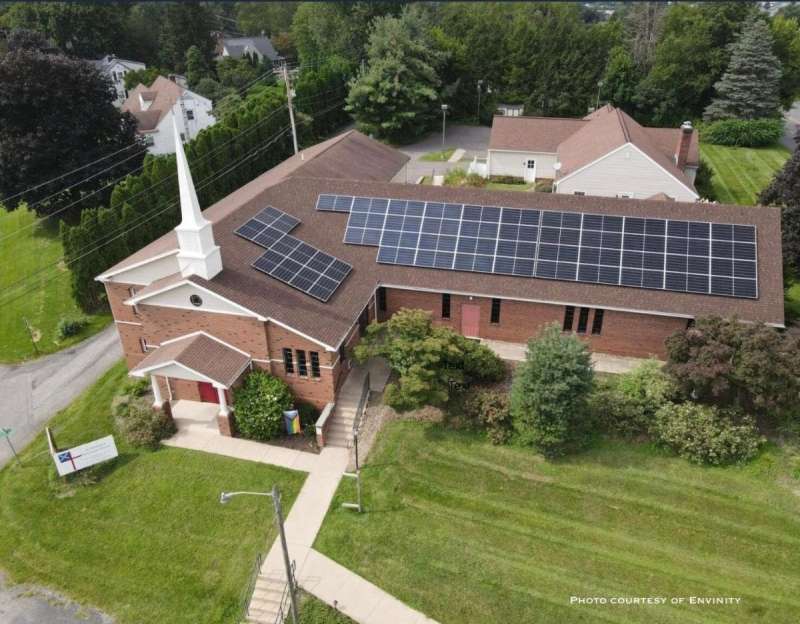
For St. Andrew’s Episcopal Church in Lewisburg and Steelton-Highspire School District in Steelton, clean energy has become a way to save money on energy costs and educate the community around them about the benefits of it.