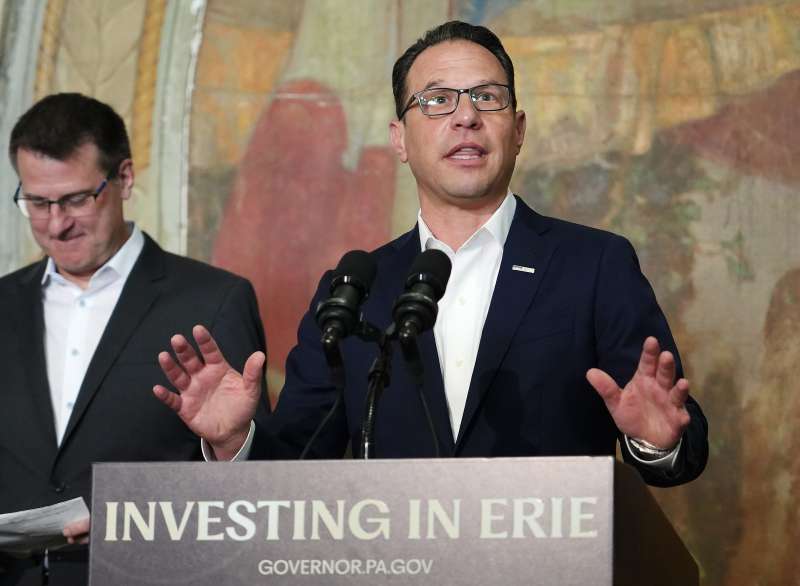
Gov. Josh Shapiro’s 2026-27 budget proposal requires nearly $6.5 billion in new revenue ― and he wants to move almost $4.7 billion from the state’s rainy day fund to balance the $53.3 billion spending proposal.
Another $1.8 billion is proposed in new taxes on skill games, recreational marijuana and reductions in entitlement spending through a minimum wage increase.
Republicans in the House and Senate oppose using the rainy day fund, citing a potential credit downgrade and the need for future tax increases if it were to be tapped.
The dispute could potentially derail an on-time budget, which is due June 30. The past four budgets have been late, and last year’s was not approved until November, nearly five months after its statutory mandate.
Shapiro’s draw on the fund would reduce it from $7.6 billion to $2.9 billion, which would be one of the largest dips in state history. The proposal claims to balance future budgets through 2030-31 with estimated revenue growth averaging 2.8% and assumed spending growth of 0.78%.
Growth averaged 5.6% annually over the past three budgets, according to the governor’s proposal.
What would rainy day fund monies cover?
Roughly $100 million of the state’s rainy day fund would be set aside for a Federal Response Fund to “mitigate actions, or inactions, by the federal government that cause disruptions to critical services or create situations that threaten the health, safety, or welfare of Pennsylvanians,” the proposal Shapiro made in February states.
An example was when food stamps, or SNAP benefits, lapsed in 2025 because of a federal shutdown.
The other proposed transfer is roughly $4.6 billion to balance the general fund spending plan. It represents $2.7 billion, or 5.4%, more than the current budget spends.
The additional money is not necessarily earmarked for specific appropriations, according to officials with the governor’s office. It would be transferred to the general fund to cover expenses including healthcare, education and other state programs.
These are funding requests for select areas of the budget that Shapiro delivered to the General Assembly in February:
Public education
- $884 million more total, including $565 million more for school districts using adequacy gap provisions enacted this year, $50 million more each for basic education and special education.
- Some other increases are planned for pupil transportation, school employees’ Social Security and school food services.
Pennsylvania State Police
- Shapiro proposed $118.5 million more, part of which would fund four new cadet classes to hire 380 troopers.
- Other increases are required to cover general operations, IT upgrades and patrol vehicles, according to the budget plan.
- There would be $2.3 million for adult-use marijuana enforcement and expungement paid for by a new marijuana tax if recreational pot were to be legalized.
Human Services
- $1.3 billion, largely for medical assistance programs.
Other hikes
- $56.1 million more to State Parks and State Forest operations under the Department of Conservation and Natural Resources.
- $46.7 million more to the judiciary.
- $44.4 million more for the Department of Environmental Protection, mostly to manage program management and protection operations.
Proposed cuts
- $513.2 million from the Department of Transportation.
- $3.4 million from the Department of Agriculture.